
Dzongri Trek: Ultimate Guide to Itinerary, Difficulty, Cost & Local Planning

Updated: Sep 30
The Dzongri Trek is one of the most rewarding short-duration Himalayan treks in India, offering panoramic views of Mt. Kanchenjunga, Mt. Pandim, and the surrounding Sikkimese peaks.
But this is no ordinary trail. The terrain is rugged, the weather unpredictable, and the route remote. There are no motorable roads beyond Yuksom, no homestays en route, and no shortcuts.
This trek cannot be done solo. You will need camping equipment, porters, a trained cook, and most importantly—a reliable local travel agent based in Yuksom who knows the trail, terrain, permits, and rescue protocols.
Outsourcing to national operators or large internet-based platforms is a risk; local agents are better equipped for on-ground challenges and emergencies.
If you feel you don't dare to go higher up. There are lots of other activities that you can do in Yuksom. You can check our list of Yuksom sightseeing and activities.
Quick Overview :
Start Point: Yuksom (1,780 m)
Highest Point: Dzongri Top (4,200 m)
Total Trek Distance : ~42 km (round trip)
Duration: 5–6 days
Dzongri Trek Difficulty: Moderate to Difficult
Permit Required: Yes. Trek permits and Khangchendzonga National Park entry formalities are arranged through an authorised local travel agent.
Dzongri Trek Cost: From around ₹19,000 per person for a group of at least 10 trekkers. A private departure for one trekker can cost ₹60,000 or more.
Best Time to Visit: April–June & Oct–Nov (Spring & Autumn)
Dzongri Winter Trek: Dec–Feb (Only for experienced trekkers)
Dzongri Trek Itinerary
Day 1: Yuksom (1,780 m) to Sachen (2,200 m)
Distance: 8 km | Time: 4–5 hrs
Highlights: Forest trail, 3 bridge crossings
Terrain: Gradual ascent, damp jungle trail
Note: First night of camping—no network, no settlements
Day 2: Sachen to Tshoka (2,950 m) via Bakhim (2,700 m)
Distance: 7 km | Time: 5–6 hrs
Highlights: Rhododendron forests, Bakhim viewpoint
Acclimatization begins here—steep altitude gain
Stay: Wooden huts or tent
Day 3: Tshoka to Dzongri (4,020 m) via Phedang (3,650 m)
Distance: 9 km | Time: 6–7 hrs
Highlights: Phedang rest stop, alpine landscapes
Note: Altitude gain is significant; pace slowly
Day 4: Acclimatization + Dzongri Top Hike (4,200 m)
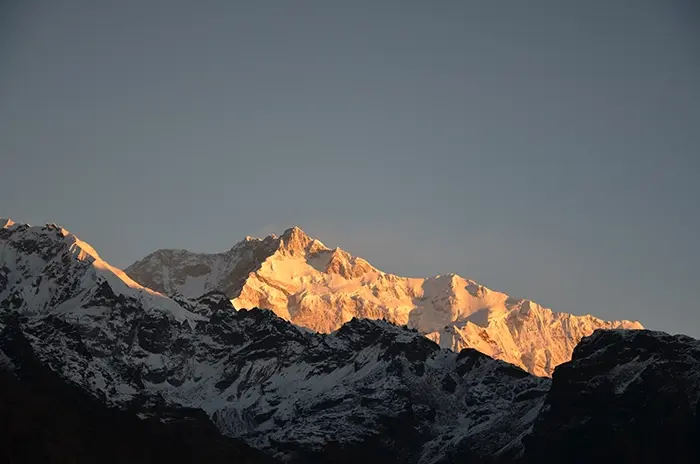
Distance: 2 km round trip | Time: 1.5 hrs
Viewpoints: Mt. Kanchenjunga, Pandim, Kabru, Rathong
Also Visit Dzongrilla Pass and Laxmi Pokhari during the day
Purpose: High point acclimatisation
Day 5: Dzongri to Tshoka
Distance: 9 km | Time: 5 hrs
Steep descent—monitor knees and pace
Day 6: Tshoka to Yuksom
Distance: 15 km | Time: 6 hrs
Final return day with forest descent and river crossings
Dzongri Trek Map (Trail Flow)
Yuksom → Sachen → Bakhim → Tshoka → Phedang → Dzongri → Dzongri Top → Return via same route
Altitude Gain: +2,420 meters from Yuksom to Dzongri Top
Network: No signal beyond Yuksom.
Water Sources: Streams near Sachen, Tshoka, and Dzongri
Dzongri Trek Difficulty
The Dzongri Trek difficulty level is moderate to difficult, based on:
Steep ascents (especially Tshoka to Dzongri)
Rapid altitude gain (over 2,000 m in 3 days)
High altitude exposure (risk of AMS)
Cold temperatures and unpredictable rain/snow
Lack of settlements or supplies beyond Yuksom
Unsupported solo trekking is not permitted. The trek must be undertaken with the required local guide and support arrangements. Private departures for individual trekkers can be organised, but they cost considerably more than group departures.
Dzongri Trek Cost Breakdown:
The Dzongri Trek cost depends heavily on the number of trekkers in the group. This is one of the most important things to understand before comparing prices online.
For a group of 10 or more trekkers, the Dzongri Trek cost can start from around ₹19,000 per person. The cost may increase depending on the trekking company, quality of equipment, food, number of support staff, accommodation, transport, baggage support, and other services included in the package.
A trek arranged privately for one person is completely different. A private Dzongri Trek for a single trekker can cost ₹60,000 or more because the trek still requires a guide, cook, supporting staff, camping equipment, food supplies, fuel, permits, and transportation of equipment regardless of whether there is one guest or ten.
Why Does a Private Dzongri Trek Cost More?
The cost of the expedition is not divided only by the distance walked.
A trekking team must carry tents, kitchen equipment, food, fuel, sleeping equipment, emergency supplies, and other camp materials into a remote part of the Himalayas. Guides, cooks, support staff, and pack animals may also be required.
With a larger group, these common expedition expenses are shared among several trekkers. With only one or two trekkers, most of the same operational expenses still exist, so the cost per person becomes much higher.
This is why comparing the price of a 10-person group departure with a private one-person departure can be misleading.
Approximate Dzongri Trek Cost for 2026
Trek Type | Approximate Cost |
Group of 10 or more trekkers | From ₹19,000 per person |
Small private group | Price varies according to group size and services |
Private departure for one trekker | ₹60,000 or more |
Foreign trekkers | Usually higher due to additional permit formalities and applicable charges |
These figures should be treated as a realistic starting point, not a fixed government rate. Every trekking company has its own service structure, staff ratio, equipment standard, meals, inclusions, and additional services.
What Is Usually Included in the Dzongri Trek Cost?
Depending on the package, the price may include trekking permits, Khangchendzonga National Park entry formalities, local guide, cook and support team, camping equipment, sleeping arrangements, meals during the trek, kitchen equipment, fuel, transportation of expedition supplies, and pack animals where required.
Some companies may include additional services, while others may charge separately for them.
Personal trekking equipment, transportation to and from Yuksom, hotel stays, baggage offloading, insurance, emergency evacuation, additional accommodation, and other optional services may not always be included.
Always check the inclusions and exclusions before comparing two Dzongri Trek packages.
Important 2026 Permit Cost Update
Khangchendzonga National Park entry and permit-related charges have increased in 2026. Older articles and trekking websites may still display previous permit rates, so those figures should not be used to calculate the present Dzongri Trek cost.
Foreign nationals may also be quoted a higher price than Indian tourists because additional permit procedures, documentation, and applicable charges are involved.
For an accurate quotation, provide the trekking company with your nationality, number of trekkers, preferred dates, and required services.
A Note About “Solo” Dzongri Trek Prices
The Dzongri Trek cannot be undertaken as an unsupported solo trek.
When we refer to a private trek for one person, it means that one guest has a dedicated departure supported by the required local trekking team. It does not mean trekking alone without a guide or support staff.
This distinction is important because a private one-person trek may cost ₹60,000 or more even though a seat in a large group departure can start from around ₹19,000 per person.
Do not choose a Dzongri Trek only because it has the lowest advertised price. Compare the group size, equipment, meals, support staff, permits, safety arrangements, and exactly what the package includes before booking.
Best Time to Visit Dzongri Trek :
Spring (April–June):
Blooming rhododendrons, clear skies, fresh trails
Ideal for photographers and beginners
Autumn (Oct–Nov):
Post-monsoon clarity, best views of Kanchenjunga
Dry and stable weather
Dzongri Winter Trek (Dec–Feb):
Snow-covered landscape
Extreme cold, high difficulty
Only for experienced trekkers with local team and proper gear
Avoid Monsoon from the march of July to September at all cost. Very high chance of trek cancellation and incomplete trek.
Why Local Travel Agents from Yuksom Matter
Hiring a Yuksom-based travel agent is not a suggestion—it is a survival necessity:
They manage permits, staff, yaks, camping gear, and food
Their familiarity with the terrain enables faster response during emergencies
In case of injury, sickness, or evacuation, local agents coordinate rescue from the trail
You directly support the local economy and hidden trekking communities, bypassing large online companies
You will rarely come across information from local travel agents. Their business info is buried inside big travel firms' dominion and aggressive marketing tactics —but locals, they are the true experts of the Dzongri Trail.
FAQs
Is Dzongri Trek Difficult?
The Dzongri Trek difficulty is generally moderate to difficult. The trail does not require technical climbing, but the steep ascent, rapid altitude gain, long walking hours, cold conditions, and remote terrain make it physically demanding. Good fitness and proper acclimatisation are important.
What is the Cost of Dzongri Trek?
For a group of 10 or more trekkers, the Dzongri Trek cost can start from around ₹19,000 per person. A private departure arranged for a single trekker can cost ₹60,000 or more because guides, cooks, support staff, food, equipment, permits, and expedition logistics are still required.
Prices vary between trekking companies according to the group size, equipment standard, food, support staff, inclusions, and additional services. Foreign trekkers may also have a higher cost because of additional permit formalities.
How to Reach Dzongri Top?
Start from Yuksom. Trek via Sachen, Tshoka, and Dzongri base camp. A short 1 km morning hike from base leads to Dzongri Top (4,200 m) for a stunning sunrise view.

Thanks and gratitudes for detailed trip information . Will connect by email for finalising a West Sikkim plan , will be glad to add Gangktok and Gurudongmar in my trip . I normally ask few friends to join me and would like to know if a Pax size of 16-20 is good for Sikkim trip or should be less nos. pl connect hkdkpandey@gmail.com